.png?width=200&height=38&name=CarCloud%20logo%2022(white).png "CarCloud logo 22(white)")
Why so many organisations have an "Accidental Fleet Manager"
Quick Answer
In many organisations, fleet management isn't handled by a dedicated fleet manager. Instead, responsibility often falls to someone in HR, Finance, Operations, Facilities or Office Management alongside their existing role. These "accidental fleet managers" find themselves responsible for vehicles, drivers, compliance and business travel without specialist training, dedicated systems or clear ownership.
If that sounds familiar, you're far from alone.
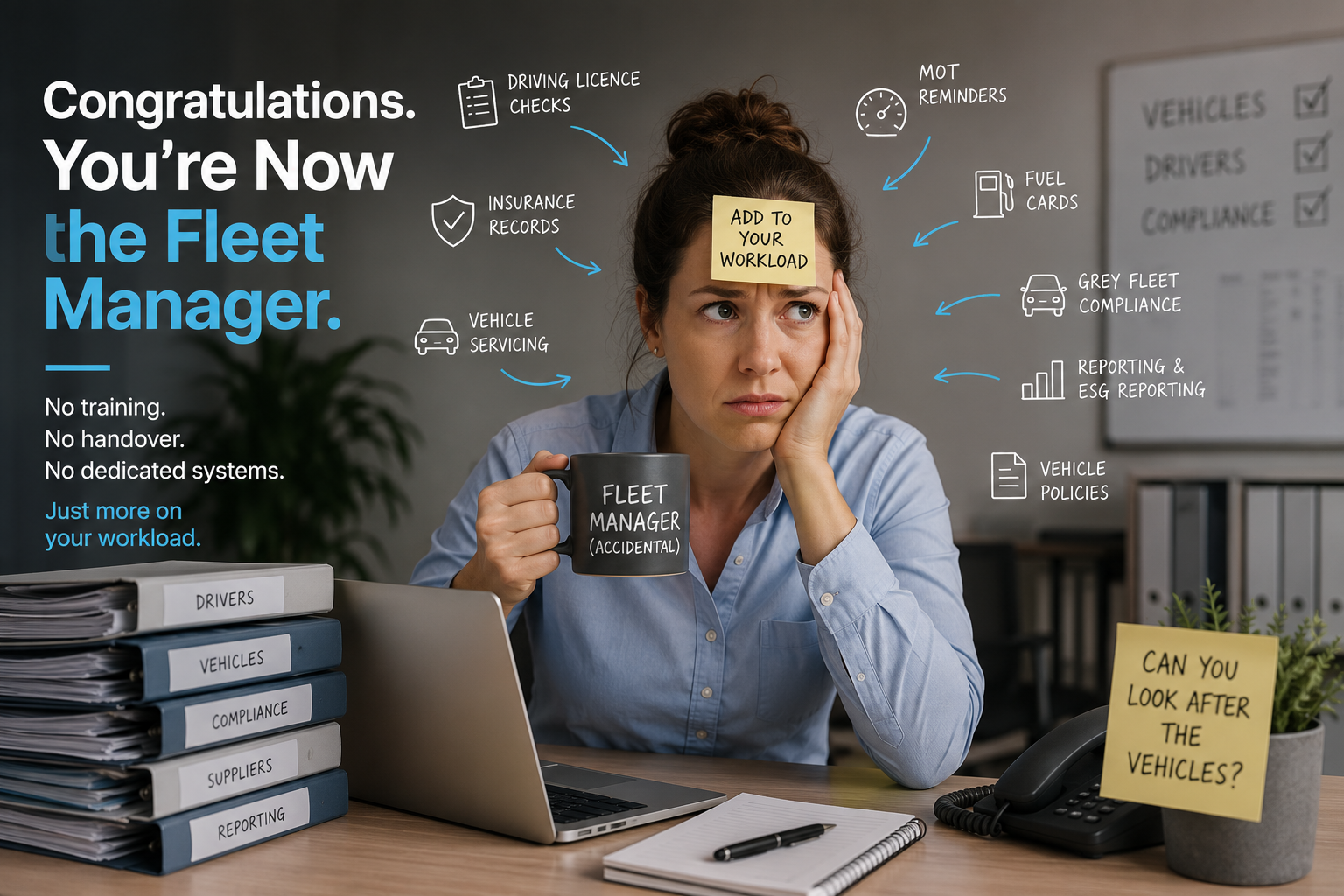
"Congratulations. You're Now the Fleet Manager."
It usually happens without anyone planning it.
A colleague leaves.
The business grows.
A company is acquired.
More employees start driving for work.
Company vehicles increase.
Grey fleet expands.
Then someone looks around the room and says...
"Can you look after the vehicles?"
No training.
No handover.
No fleet management qualification.
No dedicated software.
Just...
"Can you add it to your workload?"
Congratulations.
You're now the fleet manager.
The only problem?
Nobody told you that was your job.
What Is an Accidental Fleet Manager?
An Accidental Fleet Manager is someone whose primary role isn't fleet management but who has become responsible for managing vehicles, drivers or business travel.
That might include someone working in:
- HR
- Finance
- Operations
- Facilities
- Office Management
- Procurement
- Health & Safety
- Administration
For many organisations, vehicle and driver management evolves gradually rather than through deliberate planning.
What starts as approving a few mileage claims can quickly become responsibility for:
- Driving licence checks
- Insurance records
- MOT reminders
- Vehicle servicing
- Pool vehicles
- Fuel cards
- EV charging
- Grey fleet compliance
- Vehicle policies
- Reporting
- ESG Reporting
Before long, someone has become the fleet manager without ever applying for the role.
Why Does This Happen?
Many organisations don't believe they operate a fleet.
They think fleet management only applies to businesses with hundreds of branded vans or company cars.
In reality, organisations often manage a mix of:
- Company cars
- Vans
- Pool vehicles
- Salary sacrifice vehicles
- Employees using their own vehicles for work (grey fleet)
- Contractors travelling on business
Industry estimates suggest that around 81% of UK business journeys take place in employee-owned or contractor vehicles, making grey fleet one of the largest and least visible areas of business travel.
As organisations grow, someone has to coordinate all of that information.
More often than not, it becomes someone else's "other job."
What Does a Fleet Manager Actually Do?
Many people are surprised by just how broad the role has become.
Modern fleet management isn't simply about vehicles.
It includes responsibility for people, processes, compliance and business performance.
Depending on the organisation, responsibilities may include:
- Driver licence checks
- Business insurance verification
- MOT monitoring
- Vehicle servicing
- Mileage reimbursement
- Fuel management
- EV charging
- Driver policies
- Vehicle allocation
- Compliance reporting
- Duty of care
- Supplier coordination
- Cost management
It's no longer just about keeping vehicles on the road.
It's about giving the organisation confidence that everything connected to those vehicles is being managed effectively.
Why Fleet Management Has Become More Complex
Ten years ago, managing vehicles was relatively straightforward.
Today, organisations are navigating:
- Grey fleet growth
- Hybrid working
- Electric vehicles
- Business mileage reimbursement
- Duty of care responsibilities
- ESG reporting
- Rising operating costs
- Multiple suppliers
- Increasing compliance expectations
- Increase in contractors, outsourced service suppliers, freelancers and agency workers
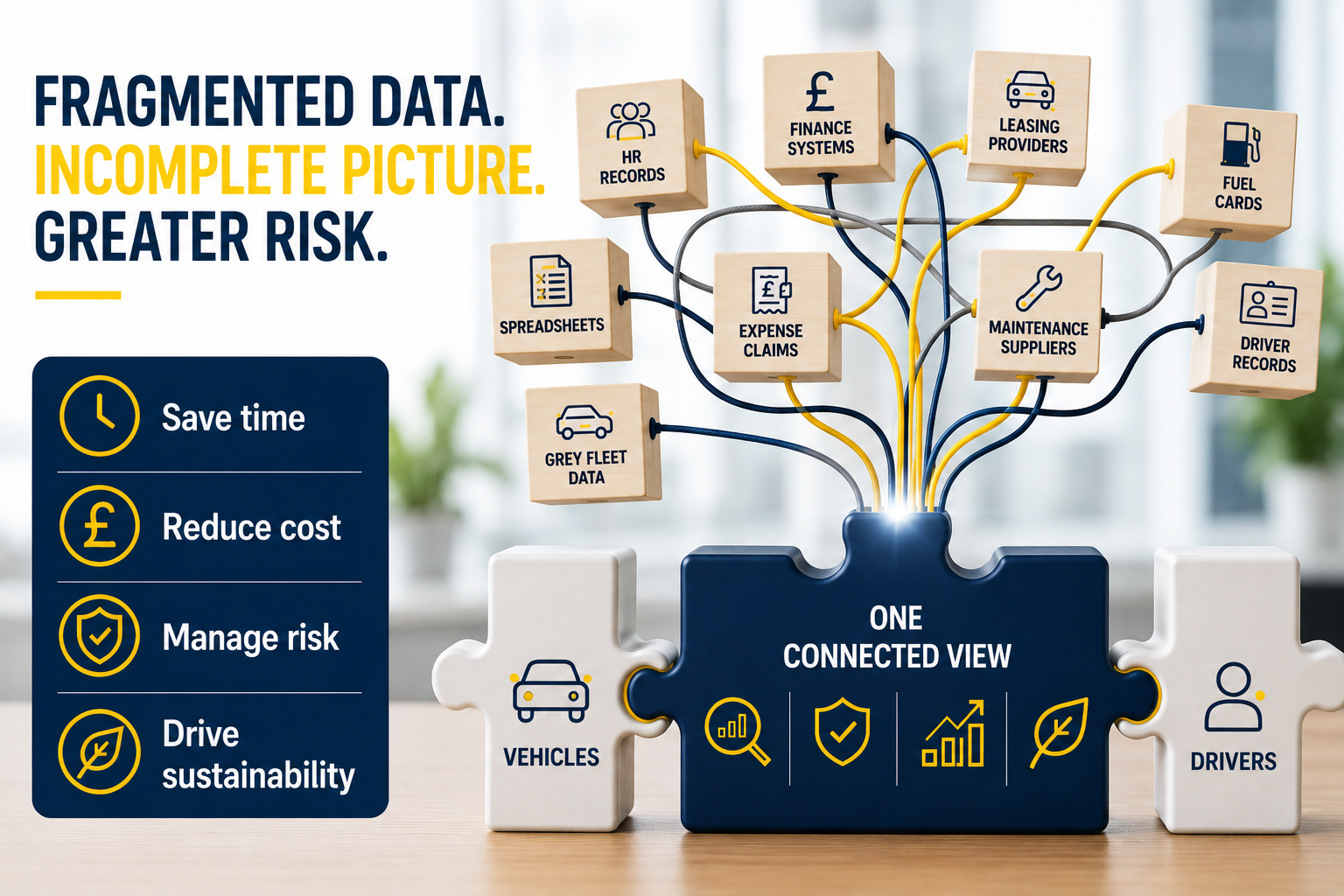
At the same time, information has become increasingly fragmented.
HR manages one part.
Finance another.
Operations another.
Facilities another.
External suppliers hold even more.
Nobody has a complete picture.
What Happens When Nobody Owns Fleet Management?
This is where organisations begin to feel the pressure.
Questions that should take minutes suddenly become difficult to answer.
For example:
- Who is driving for work today?
- Which employees require business insurance?
- Whose MOT expires next month?
- Which vehicles are due for servicing?
- How much are we spending on business mileage?
- Can we demonstrate our duty of care?
- Who owns responsibility for grey fleet?
Finding those answers often means opening multiple spreadsheets, searching inboxes and contacting several departments.
The challenge isn't usually a lack of effort.
It's fragmented information.
Signs You've Become an Accidental Fleet Manager
You might recognise yourself if you:
✅ Chase colleagues for insurance documents.
✅ Send reminders about MOT renewals.
✅ Approve mileage claims.
✅ Keep a spreadsheet called "Fleet."
✅ Organise vehicle servicing.
✅ Answer questions about company vehicles.
✅ Coordinate fuel cards.
✅ Don't actually have "Fleet Manager" in your job title.
If you're smiling...
You're probably an Accidental Fleet Manager.
Why This Matters
Vehicle and driver management has become much more than an operational task.
It now influences:
- Compliance
- Employee experience
- Operational efficiency
- Business continuity
- Financial reporting
- ESG reporting
- Organisational governance
As responsibility grows, organisations need greater confidence that information is accurate, accessible and connected.
The role may have started by accident.
Managing it successfully shouldn't depend on luck.
Frequently Asked Questions
Who is responsible for fleet management?
This depends on the organisation.
Many businesses allocate responsibility to HR, Finance, Operations, Facilities or Office Managers where there isn't a dedicated fleet team.
What is an Accidental Fleet Manager?
An Accidental Fleet Manager is someone whose primary role isn't fleet management but who has inherited responsibility for vehicles, drivers, compliance or business travel alongside their existing role.
Do I need a dedicated fleet manager?
Not necessarily.
Many organisations successfully manage vehicles without a dedicated fleet manager, provided there is clear ownership, consistent processes and the right technology to support them.
Who manages grey fleet?
Grey fleet responsibilities often sit with HR, Finance, Operations or Health & Safety, although ownership varies between organisations.
What are the responsibilities of a fleet manager?
Responsibilities commonly include:
- Driver management
- Vehicle management
- Licence checks
- Business insurance
- Vehicle servicing
- Compliance
- Mileage
- Fuel and EV charging
- Reporting
- Supplier management
Do I need fleet management software?
For many organisations, yes. As your business grows, spreadsheets and manual processes can become difficult to manage, making it harder to maintain visibility, reduce administration and stay on top of compliance.
The key is choosing software that matches the way your organisation operates. If you manage a mix of company vehicles and employees using their own vehicles for work (grey fleet), look for a solution that brings everything together in one place, rather than relying on separate systems.
A single view of your drivers, vehicles and compliance can help improve oversight, reduce risk and support better decision-making as your organisation grows.
The Bottom Line
Most organisations don't deliberately appoint an Accidental Fleet Manager, the role simply evolves.
The challenge isn't that people aren't capable, It's that they're often expected to manage increasingly complex responsibilities without the visibility, tools or support they need.
The organisations getting this right aren't asking people to work harder. They're making it easier for them to succeed by connecting information, simplifying processes and giving them confidence in the decisions they're making.
Because modern vehicle and driver management isn't really about vehicles.
It's about helping organisations perform better.
How CarCloud Helps
Whether you're a dedicated Fleet Manager or an Accidental Fleet Manager, having the right information at the right time makes all the difference.
CarCloud helps organisations reduce costs, reduce risk and gain greater visibility by bringing vehicle, driver, compliance and operational data together into one connected platform.
With CarCloud, organisations can:
- Reduce operational costs by cutting manual administration and helping avoid preventable compliance issues.
- Identify and reduce risk before issues become costly problems.
- Automate the collection and monitoring of compliance information, reducing the time colleagues spend chasing documents and deadlines.
- Maintain a complete digital audit trail across vehicles, drivers and business journeys, supporting stronger governance and demonstrating compliance.
- Bring company vehicles and grey fleet together into a single, connected view.
- Improve ESG reporting, compliance oversight and business decision-making through better visibility and more accurate data.
Could you answer these questions today?
- Who is driving for work?
- Which licences need checking?
- Whose business insurance expires next?
- What's your true cost of business travel?
- Could you demonstrate your duty of care with confidence?
If answering those questions would involve opening multiple spreadsheets or contacting several departments, you're not alone.
Discover how CarCloud helps organisations simplify vehicle and driver management and improve business performance.
👉 Visit www.carcloudsolutions.com