.png?width=200&height=38&name=CarCloud%20logo%2022(white).png "CarCloud logo 22(white)")
Imagine you've spent weeks preparing a tender for a valuable new contract.
Your pricing is competitive, your service stands out, and your team is ready.
Then one question appears:
"Can you provide evidence of your transport emissions, business mileage and ESG reporting?"
For many organisations, that's where things become difficult.
The information exists, but it's spread across finance systems, HR records, leasing providers, spreadsheets, fuel cards and expense claims. Bringing it together quickly isn't easy.
As environmental reporting becomes more important across both the public and private sectors, this hidden data gap is becoming a genuine commercial risk.
Why are businesses being asked for ESG information?
Environmental, Social and Governance (ESG) reporting has moved beyond large corporate sustainability reports.
Customers, investors and procurement teams increasingly want confidence that the organisations they work with understand and manage their environmental impact.
For businesses that operate vehicles, that often means being asked questions such as:
- How much business mileage do you record?
- How are transport emissions monitored?
- What proportion of your fleet is electric?
- How do you manage employees using their own vehicles for business?
- Can you evidence improvements over time?
These questions are becoming more common during supplier assessments, contract renewals and tender processes.
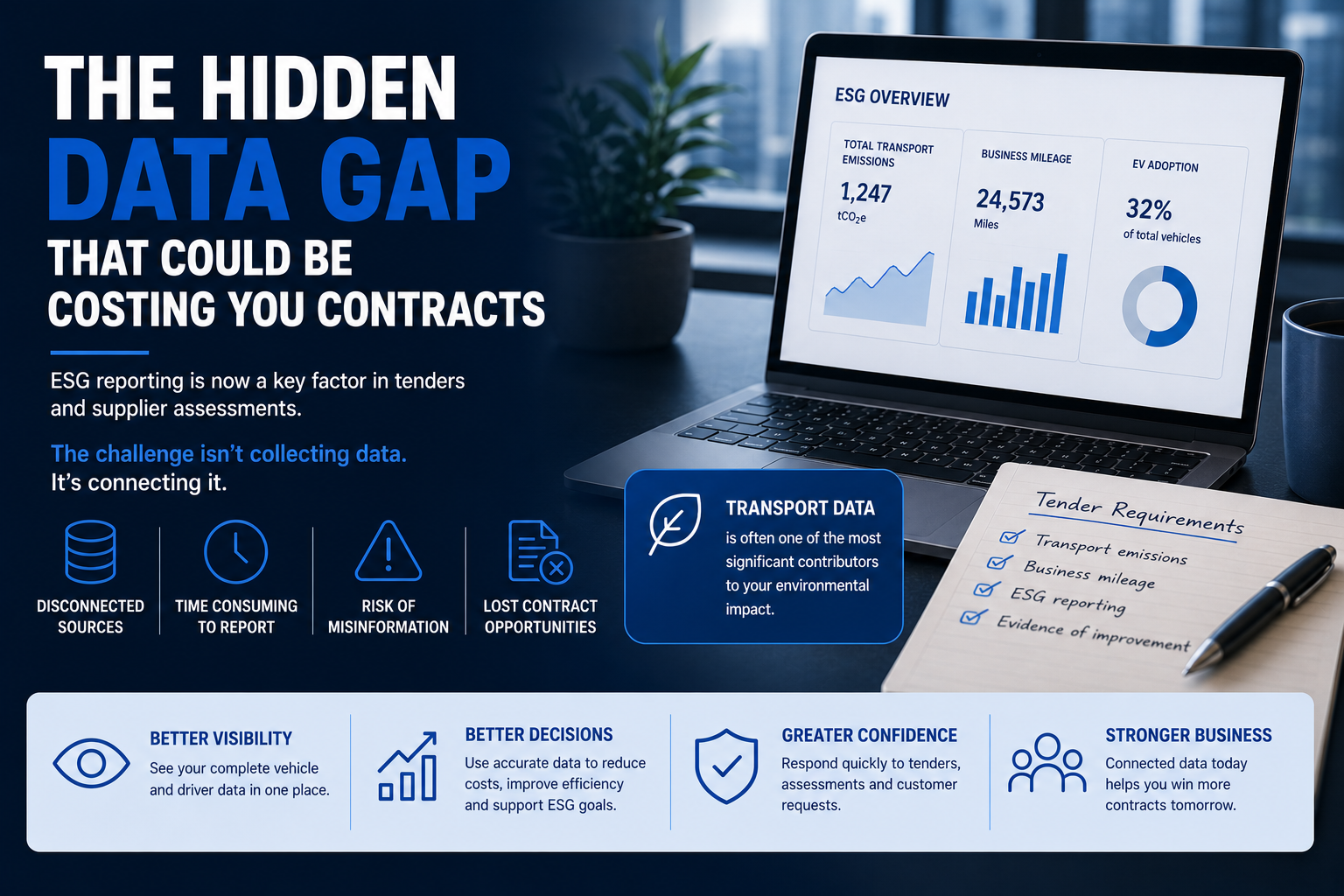
The challenge isn't collecting data. It's connecting it.
Most organisations already have the information they need.
The problem is that it's rarely held in one place.
Business mileage may sit in expense systems.
Vehicle information may be managed by finance or leasing providers.
Driver records often belong to HR.
Maintenance history lives with suppliers.
Fuel data may be held by separate providers.
When every department owns a different piece of the puzzle, producing accurate reports becomes time-consuming and often reactive.
Why vehicle data matters for ESG reporting
Transport is often one of the most significant contributors to an organisation's operational emissions.
Understanding vehicle activity can help businesses report more accurately while also identifying opportunities to reduce cost, improve efficiency and support sustainability objectives.
Useful vehicle data includes:
- Business mileage
- Vehicle utilisation
- Fuel consumption
- Electric vehicle adoption
- Grey fleet activity
- Driver compliance
- Vehicle lifecycle information
Having visibility across this information allows organisations to make decisions based on evidence rather than assumptions.
The hidden ESG challenge: Grey fleet
One area that is frequently overlooked is the grey fleet.
Grey fleet refers to employees using their own vehicles for business journeys.
For many organisations, this represents a significant proportion of business travel, yet visibility is often limited.
Without understanding who is driving, how frequently journeys are taking place or the environmental impact of those trips, organisations may struggle to build a complete picture of their transport-related emissions.
Improving visibility into grey fleet activity not only supports ESG reporting but can also strengthen compliance and duty of care.
Better visibility leads to better decisions
Reliable data supports far more than environmental reporting.
It enables organisations to:
- Identify opportunities to reduce unnecessary journeys.
- Improve vehicle utilisation.
- Support electric vehicle transition planning.
- Strengthen compliance.
- Reduce administrative effort.
- Respond more confidently to customer and procurement requests.
Ultimately, better visibility enables better business decisions.

How CarCloud helps
CarCloud brings together vehicle, driver and operational information into a single connected platform.
Rather than replacing the systems businesses already use, CarCloud helps organisations gain a clearer view of their vehicle operations by connecting data that would otherwise remain fragmented.
This gives finance, operations, HR and leadership teams greater confidence in the information they rely on, whether they're managing vehicles day-to-day, preparing ESG reports or responding to tender questions.
As reporting expectations continue to grow, having connected, reliable vehicle data is becoming less of a competitive advantage and more of a business necessity.
Frequently Asked Questions
What vehicle data should be included in ESG reporting?
Useful data typically includes business mileage, fuel consumption, vehicle utilisation, electric vehicle adoption, maintenance records and grey fleet activity.
What is a grey fleet?
A grey fleet consists of employees who use their own vehicles for business journeys rather than company-owned vehicles.
Why is vehicle data important for ESG?
Vehicle data helps organisations understand transport-related emissions, improve operational efficiency and provide evidence during ESG reporting and procurement processes.
What is Scope 3 reporting?
Scope 3 emissions include indirect emissions generated throughout an organisation's value chain. Business travel, including employee-owned vehicles used for work, can form part of these emissions depending on the reporting framework being used.
How can businesses improve ESG reporting?
Improving visibility across vehicle, driver and operational data helps organisations produce more accurate reports, identify opportunities for improvement and respond more confidently to customer requests.
How does CarCloud support ESG reporting?
CarCloud provides a connected view of vehicle and driver information, helping organisations access the operational data needed to support compliance, reporting and informed decision-making.
What is the Corporate Sustainability Reporting Directive (CSRD)?
The Corporate Sustainability Reporting Directive (CSRD) is an EU sustainability reporting regulation. It requires many organisations operating within the European Union to report detailed information about their environmental, social and governance (ESG) performance.
The CSRD does not generally apply to businesses that operate solely within the UK. However, UK organisations may still be affected if they:
- Operate in EU countries.
- Have subsidiaries within the EU.
- Supply goods or services to organisations that are required to comply with CSRD.
In these cases, businesses may be asked to provide more detailed information about areas such as business travel, transport emissions and vehicle-related activity.
Having accurate, connected vehicle and driver data can make responding to these requests significantly easier.